
The Quick Version
- Lake Blue Ridge water levels follow a TVA guide curve: about 1,665 feet above sea level on January 1 and about 1,687 feet in early June.
- The winter drawdown starts in August and runs to New Year’s, roughly 22 feet in a normal year.
- On September 30, 2026 the lake read 1,675.77 feet, right on the curve.
- The dam was finished in 1930 by the Toccoa Electric Power Company; TVA has owned it since 1939. Last updated October 2026.
Lake Blue Ridge water levels are set by a schedule, not just by the weather. In a normal year the Tennessee Valley Authority moves the lake about 22 feet, from a winter low near 1,665 feet above sea level to a summer high near 1,687. At midnight on September 30, 2026, the gauge at Blue Ridge Dam read 1,675.77 feet.
This guide covers the dam itself, who built it and why, how the guide curve works, and what the drawdown looks like from a dock. We pulled TVA’s own daily data to show what the lake actually did in 2025 and 2026. For access points, camping, and the town, start with our local’s guide to Lake Blue Ridge.
When was the Blue Ridge Dam built, and why?
Between 1925 and 1930, to make electricity for a private utility. The Toccoa Electric Power Company, a subsidiary of the Tennessee Electric Power Company (TEPCO), began construction in November 1925 and completed the dam in December 1930, according to TVA’s 2009 environmental assessment of the dam. The powerhouse went into commercial operation in July 1931.
It was a showpiece. TVA’s history of the project says that when it went into service on July 1, 1931, Blue Ridge was “the most modern hydroelectric power production facility in the TEPCo system and the largest earthen dam in the Southeast.” The equipment was largely automatic, so it needed few attendants.
The builders used a method called semi-hydraulic filling, in which water helps place the earth. TVA notes that the technique “is no longer used in modern dam construction,” a detail that matters again in 2026.
What has changed at the dam since TVA took over?
Ownership in 1939, and one major repair that emptied much of the lake. TVA acquired Blue Ridge Dam from TEPCO in 1939. The longest-running problem dates to 1931, when the steel penstock, the pipe that feeds the turbine, partially collapsed after it was drained with a full reservoir.
| Date | Event |
|---|---|
| November 1925 | Construction begins |
| December 1930 | Dam completed |
| July 1931 | Commercial power begins; penstock damaged soon after |
| 1939 | TVA acquires the dam |
| July 2010 | Deep drawdown begins for penstock repair |
| March 24, 2011 | Liner phase done; refill begins |
| July 11, 2011 | Generation resumes |
That repair is the one long-time owners remember. TVA said in July 2011 that the lake had been “as low as 65 feet below normal levels over the past year.” Before it, TVA drained the lake deeply about every five years to inspect the penstock.
What is hydroelectric energy, and what does Blue Ridge Dam release?
Hydroelectric energy is power made by water falling through a turbine. At Blue Ridge, lake water drops from the intake through the penstock to a single generating unit at the foot of the dam. TVA’s Blue Ridge dam page lists that unit at a net dependable capacity of 16 megawatts.
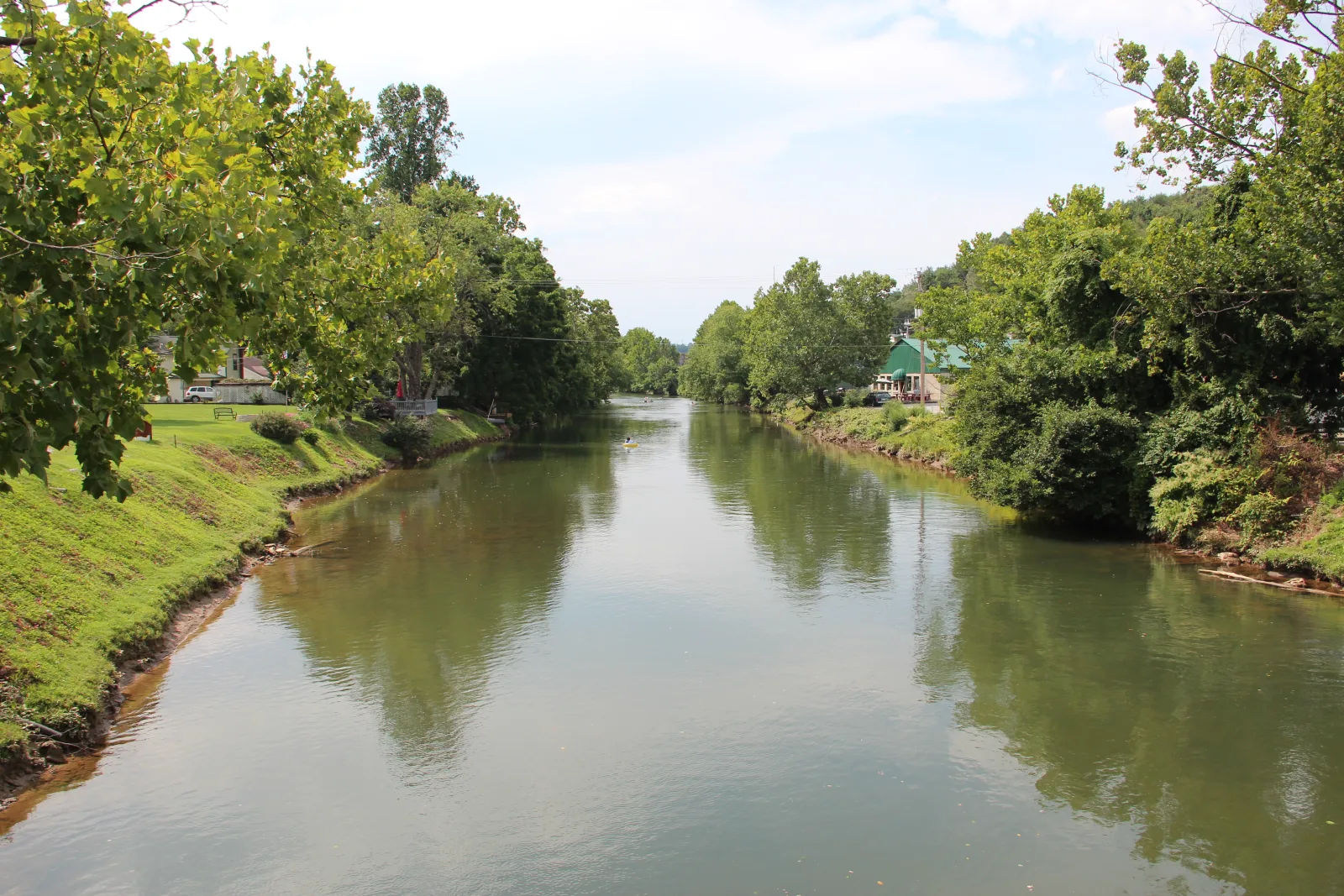
Generation comes in pulses. In TVA’s hourly data for September 29, 2026, the dam released about 153 cubic feet per second most of the day, then ran at about 1,640 to 1,680 for two blocks of three hours: late morning and early evening. Each pulse lifted the river below the dam about 2.8 feet within two hours.
That is why the Toccoa below the dam can change fast. TVA’s warning is blunt: “Large amounts of water could be discharged at any time.”
How does the TVA guide curve set Lake Blue Ridge water levels?
It is a target line for every day of the year. TVA’s operating guide plots that curve against an expected range that, in its words, the lake falls within “on average in 8 out of every 10 years on any given day.” These are the curve values we pulled from TVA’s Blue Ridge operating guide on October 1, 2026.
| Date | Guide curve (ft) | Feet above Jan. 1 |
|---|---|---|
| January 1 | 1,664.8 | 0 |
| March 1 | 1,670.95 | 6.2 |
| May 1 | 1,683.01 | 18.2 |
| June 4 (peak) | 1,686.9 | 22.1 |
| August 1 | 1,685.83 | 21.0 |
| October 1 | 1,675.63 | 10.8 |
| December 1 | 1,666.37 | 1.6 |
The peak-to-trough spread is 22.1 feet, which is where TVA’s “about 22 feet” comes from.
When does the winter drawdown start, and how fast does it drop?
It starts quietly in August and does most of its work in the fall. The curve slips only about a foot from June 4 to August 1, then falls 3.5 feet in August and another 6.7 in September. From October 1 to January 1 it drops the last 10.8 feet, about 0.12 feet a day on average.
The reason is flood room. TVA says the level “varies about 22 feet from summer to winter to provide seasonal flood storage,” and the reservoir holds 68,500 acre-feet of it. Winter and spring storms in the North Georgia mountains fill that empty space first.
Refill runs the other way. The curve climbs from January through May and gains about 12 feet between March 1 and May 1 alone, so most coves look like summer again by Memorial Day.
What did Lake Blue Ridge actually do in 2025 and 2026?
It tracked the curve closely in 2025 and ran short in summer 2026. We tallied TVA’s midnight readings from the same operating-guide data feed.
- 2025 peaked at 1,688.54 feet on May 19 and stayed inside TVA’s expected range on 360 of 365 days.
- The lake bottomed at 1,667.94 feet on December 18, 2025, a fall of 20.6 feet from that peak.
- 2026 peaked lower, at 1,685.63 feet on June 1.
- It sat below the expected range every day from June 10 to August 2, 2026, 54 days in a row.
- The summer low came on July 27 at 1,681.01 feet, about 5 feet under the curve.
By September 30 it was back on line at 1,675.77. Our read: the curve is the plan, and rainfall decides how closely the lake keeps to it.
How do TVA lake levels and winter drawdowns affect lakefront owners?
They decide what your shoreline looks like for about half the year. A cove with 4 feet of water at the dock in July can show mud and rock by January, and a boat left on a shallow lift can end up sitting on the bottom.
- Plan to move the boat before the October and November drop, not after.
- Judge any dock by its January depth, roughly 20 feet below its June depth in a normal year.
- Expect the fall shoreline to show a band of bare bank.
TVA’s Blue Ridge lake levels page posts observed levels through the day, predicted levels by 1 p.m. Eastern, and next-day release schedules usually by 6 p.m. Dock size and shoreline rules are their own subject, covered in our guide to living on Lake Blue Ridge.
What is TVA studying at Blue Ridge Dam now?
Whether the dam needs major work. TVA says the dam is safe for normal operations, but its Blue Ridge Dam safety study explains that the 1930 fill method “makes it vulnerable to a strong earthquake,” and that the concrete spillway chute has deteriorated. The study is scheduled for completion in 2026.
For the lake, two lines from that page matter. TVA reports “no active plans to alter seasonal levels of the reservoir pool,” and it also notes that “it is a common practice to lower reservoir levels for extended periods during the construction of major dam remediations.” The 2010 to 2011 repair shows what that can look like. TVA has added a siren warning system at the dam and coordinates with the Fannin County Emergency Management Agency.
What should a buyer take from all this?
That water depth is a calendar question. I’m Thomas Echea, a Blue Ridge real estate agent and Luxury Real Estate Advisor with E+E Group at Compass, and I tell lake buyers to see a property between December and February before they fall for the July photos.
When a GAMLS listing says lakefront, ask how deep the water is at the dock on January 1, and check TVA’s chart for that cove’s elevation. If moving water appeals more, compare river vs. lake waterfront in Blue Ridge or look at Toccoa River cabins above the lake. For the summer side of the calendar, see our Lake Blue Ridge fishing and boating playbook.
Frequently Asked Questions
What is hydroelectric energy?
Hydroelectric energy is electricity made by water falling through a turbine. At Blue Ridge Dam, water from the lake runs through a single steel penstock to one generating unit, which TVA rates at a net dependable capacity of 16 megawatts.
When was the Blue Ridge Dam built, and why?
The Toccoa Electric Power Company, a TEPCO subsidiary, built it between November 1925 and December 1930 to generate electricity. Commercial power began in July 1931, and TVA acquired the dam in 1939.
How do TVA lake levels and winter drawdowns affect lakefront owners?
The lake drops about 22 feet from summer to winter, so shallow coves and docks can go dry by January. Owners move boats before the fall drop, judge docks by their winter depth, and check TVA’s daily levels and release schedules.
How low does Lake Blue Ridge get in winter?
TVA’s guide curve bottoms at 1,664.8 feet on January 1. In practice the lake reached 1,667.94 feet on December 18, 2025, about 20.6 feet below its 2025 peak.
When does Lake Blue Ridge fill back up?
The guide curve climbs from January through May and peaks at 1,686.9 feet on June 4. Most of the gain comes in spring, about 12 feet between March 1 and May 1.
Where can I check Lake Blue Ridge water levels?
On TVA’s Blue Ridge lake levels page or the TVA Lake Info app. Observed levels update through the day, predicted levels by 1 p.m. Eastern, and next-day release schedules usually by 6 p.m.
Is TVA going to lower Lake Blue Ridge for dam repairs?
TVA reports no active plans to change seasonal levels. Its Blue Ridge Dam safety study is due in 2026, and TVA notes that lowering a reservoir for an extended period is common during major dam repairs.