
The Quick Version
- Finding 50+ acres of rural land in the North Georgia mountains is a supply problem. Union County recorded five such sales among 1,081 transactions since January 2025.
- Per-acre prices fall as tracts grow, from a $30,000 median on 1 to 5 acres to $7,477 on those five large tracts.
- About 82% of private 50-acre parcels there carry a conservation use covenant, and a breach costs twice the tax savings.
- Price the covenant, timber, access, and survey before the per-acre number. Last updated September 2026.
Big mountain tracts are scarce, and many never reach a listing site. In Union County, only 5 of 1,081 recorded sales between January 2025 and August 2026 involved a parcel of 50 acres or more. Those five closed at a median of $7,477 an acre.
This guide covers where large acreage comes from and how to avoid overpaying for it. For the purchase steps on any lot, start with our hub on how to buy mountain land.
Where do 50+ acres of rural land come from in the North Georgia mountains?
Predominantly from families, not corporations or institutional investors. I pulled Union County’s 2026 assessor parcel file, published as a public county GIS layer, and set aside tax-exempt owners. That left 224 private parcels of 50 acres or more, covering 23,012 acres, or 21.9% of all privately held acreage in the county.
The ownership records are revealing: 184 of those 224 parcels are held by individuals, trusts, or estates (166 individuals, 15 trusts, 3 estates). Another 40 sit in LLCs, corporations, or partnerships, and none carries a timber company’s name.
Large acreage here typically changes hands through estate settlements, family partitions, and owners retiring from agriculture. The public land is the other half of the map: the U.S. Forest Service holds about 96,800 acres in Union County, roughly 47% of its mapped parcel acreage. Our guide to whether you can own a mountain covers what that federal ownership means next door.
How often does a 50-acre tract actually sell?
Infrequently enough that patience becomes the working strategy for most acreage buyers. Five sales of 50+ acres in roughly 19 months works out to about one every four months, or 0.5% of the county’s recorded sales.
Many large tracts trade with minimal marketing, often before anyone outside the family knows they are available. A neighbor purchases the adjoining pasture, one sibling buys out the others, or an executor accepts the first credible offer. A buyer who waits for a listing alert on GAMLS will see only part of the supply.
That does not make the MLS irrelevant, since it remains where priced, surveyed, and professionally marketed tracts appear, and our explainer on how the MLS works in Blue Ridge shows how to search it by acreage. It simply means the best tract may reach you through a phone call.
What does rural land cost per acre as tracts get bigger?
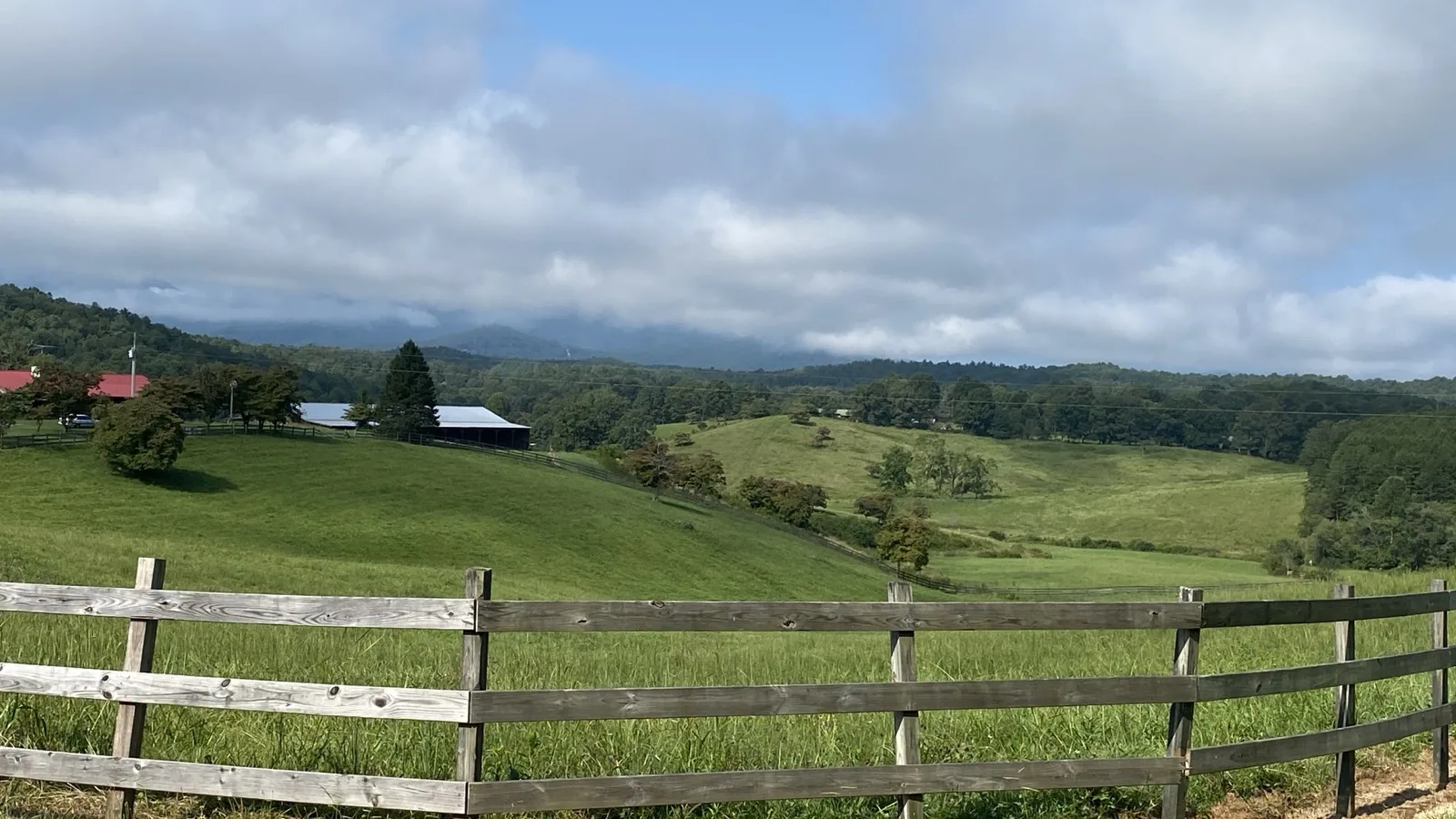
Considerably less per acre, and the decline is consistent across every size category. I sorted 319 land sales from Union County’s assessor sales file, January 2025 through August 2026, by parcel size. The median price per acre falls from $53,274 on lots under an acre to $7,477 on tracts of 50 acres or more.
| Tract size | Land sales | Median price per acre | Median sale price |
|---|---|---|---|
| Under 1 acre | 46 | $53,274 | $49,000 |
| 1 to 5 acres | 217 | $30,000 | $50,000 |
| 5 to 10 acres | 26 | $21,008 | $150,100 |
| 10 to 25 acres | 23 | $16,760 | $209,500 |
| 50 acres or more | 5 | $7,477 | $464,554 |
Only two land sales fell between 25 and 50 acres, too few to report. Acreage comes from the 2026 parcel file, so a tract divided after its sale would appear under its current size.
Why does a big tract sell for less per acre?
Because fewer buyers can finance the purchase, and most of the ground is not a homesite. On the table above, a 50-acre tract costs about a quarter as much per acre as a 1 to 5 acre lot.
The five big-tract sales ranged from $3,959 to $20,000 an acre, so the spread matters more than the median. Road frontage, pasture, a buildable pad, and a creek pull a tract toward the top. Steep timber and a long private road pull it down.
The right comparison is therefore tract to tract, not tract to lot. Our roundup of where cheap mountain land really sits covers the smaller-lot side of the market.
How common are conservation use covenants on big tracts?
On large acreage, covenants are the norm rather than the exception. Of Union County’s 224 private parcels of 50 acres or more, 184 carry a conservation use covenant year in the 2026 parcel file. That is 82.1% of the parcels and 85.5% of their acreage.
The program is Georgia’s Conservation Use Valuation Assessment, or CUVA, under Official Code of Georgia Annotated § 48-5-7.4. The owner agrees by covenant to keep the land in qualifying agricultural or timber use for ten years, and the county taxes it on that use rather than market value. One owner can place no more than 2,000 acres under the program.
A separate program, the Forest Land Protection Act, starts at 200 acres. The Georgia Department of Revenue requires at least 200 acres in aggregate, in parcels of at least 100 acres in any given county.
What happens if a CUVA covenant is broken after you buy?
The penalty can follow the land to a new owner, because it becomes a lien on the tract. Under the statute, a breach costs twice the difference between the taxes paid under the covenant and the taxes otherwise due. That multiplier applies to each completed or partially completed year, across the entire tract.
Resales are where buyers get caught. Under O.C.G.A. § 48-5-7.4, a qualified buyer may continue the covenant for the rest of its ten-year term by filing a continuation application. If the buyer does not, the sale itself breaches the covenant, and the penalty becomes a lien on all the land originally in it.
Counties read the liability differently. Douglas County’s CUVA guidance assesses penalties to both the original and the new owner, while Morgan County holds the original owner responsible for the years before the sale. On either side of the deal, I write continuation into the purchase contract.
A worked example, using hypothetical numbers: a covenant saves $2,000 a year, and you convert the land to a non-qualifying use in year six. Six years of savings is $12,000, so the penalty is $24,000 plus interest. Our guide to Fannin County property taxes covers the regular tax bill you would owe afterward.
How do you check the timber, access, and survey?
With three professionals, each engaged before the due diligence period expires. On a wooded tract, the timber can be a real share of the price or close to nothing if it was cut recently.
- Timber: Ask a registered forester for a cruise, and ask the seller for the harvest history.
- Access: Confirm a recorded easement to a public road, not a forest road you have been driving on.
- Survey: Order a new boundary survey, because older deeds on large tracts frequently describe boundaries by creeks, fences, and individual trees.
- Covenant: Have your Georgia closing attorney pull any recorded CUVA covenant and its start year.
Our field guide to walking a mountain lot in Blue Ridge shows what to inspect on foot. Once you choose a homesite, our look at building on mountain land covers septic and power.
How do you find a 50-acre tract before it is listed?
Work the channels the county records reveal, starting well before any tract is formally listed. I’m Thomas Echea, a Blue Ridge real estate agent with E+E Group at Compass and 25+ years in real estate. This is the sequence I follow with acreage buyers.
- Set a GAMLS alert for tracts of 50 acres or more across Fannin, Union, and Gilmer.
- Ask surveyors, foresters, and closing attorneys which families are settling estates.
- Write to the owners of adjoining pasture, politely and once.
- Check each covenant’s start year, since a 2017 covenant runs through December 2026.
- Line up land financing for a mountain property before the call comes.
Most of these tracts go to the buyer who was already prepared when the family decided to sell.
Frequently Asked Questions
Where is the cheapest rural land for sale?
In the North Georgia mountains, the lowest per-acre prices sit on large tracts, not small lots. Union County’s five sales of 50+ acres since January 2025 had a median of $7,477 an acre, against $30,000 for parcels of 1 to 5 acres.
What is the best way to find inexpensive land for sale?
Buy more acreage and fewer amenities, then negotiate on the features the tract lacks. Per-acre prices fall as tracts grow, and tracts without road frontage or open pasture sit at the bottom of the range. Then price the access, survey, and any conservation use covenant before you call it inexpensive.
How do you find 50+ acres of land cheaply?
Look beyond public listings and cultivate local relationships. Large tracts often sell through estates, family buyouts, and neighbors, so surveyors, foresters, and closing attorneys usually hear about them first, while a GAMLS acreage alert catches the remainder.
Can you buy land that is under a conservation use covenant in Georgia?
Yes. A qualified buyer can file to continue the covenant for its remaining term; if the buyer does not, the sale itself is a breach. A breach costs twice the tax savings for each covenant year, plus interest, and that penalty becomes a lien on the land.
How much of Union County, Georgia is national forest?
About 96,800 acres, roughly 47% of the county’s mapped parcel acreage, is held by the U.S. Forest Service according to the county’s 2026 parcel file. That federal ownership is one reason private tracts of 50 acres or more are scarce.