
The Quick Version
- Blue Ridge art galleries start at The Art Center, 420 West Main Street, inside the 1937 Fannin County Courthouse.
- The Art Center keeps six gallery spaces and opens Tuesday to Sunday; it is closed Mondays.
- East Main Street adds private galleries for fine art, folk pieces, and blown glass from more than 75 artists.
- Fall Arts in the Park runs October 10 and 11, 2026, with 170-plus booths. Last updated October 2026.
Downtown Blue Ridge concentrates a serious art scene into a few walkable blocks. Its anchor is a nonprofit arts council that has run its festival for 50 years and now fills a former courthouse with six gallery spaces, studios, and a class calendar. Around it, a handful of owner-run galleries on East Main Street cover painting, folk art, framing, and glass.
This is the gallery-day version of the town: where to start, which rooms are worth the time, where the old mountain crafts still get taught, and how the scene stacks up against Asheville. For the shops in between, see our local’s guide to Main Street shopping.
Where should a gallery day in downtown Blue Ridge start?
At The Art Center, 420 West Main Street. The Blue Ridge Mountains Arts Association took over the historic Fannin County Courthouse, built circa 1937, after the county finished its new courthouse in 2004. Three years of remodeling followed, and the first exhibit opened in 2007.
Since then the building has hosted more than 80 exhibitions. It holds six gallery spaces, among them the Richard Low Evans Courtroom Gallery, plus a dance studio, an art supply store, and the Summit Studios, rental spaces added in 2012 where working artists sell directly.
Hours as of October 2026 are Tuesday through Saturday, 10 a.m. to 6 p.m., and Sunday, 11 a.m. to 5 p.m. The building is closed Mondays. The current watercolor show, Ann Litrel’s Georgia Natural Wonders, opened September 5, 2026, and a textile exhibition called Common Threads opens with a free public reception on Friday, October 30, from 5 to 7 p.m.
Which Blue Ridge art galleries line East Main Street?
Three private galleries merit a planned stop, and each covers distinct territory. High Country Art, at 715 East Main Street, says it has supported local and regional artists for over 30 years, with fine, traditional, folk, and impressionist work in one room.
4 Elements Art, at 491 East Main Street, is both a fine art gallery and a custom framing shop. Its owner, George Charriez, has worked as a fine artist for more than 30 years, and the framing is done on site. If you buy a canvas on Saturday, this is where it can be framed before you drive home.
Multitudes Gallery leans on hand blown glass. It represents more than 75 glass artists from across the United States, alongside regional jewelry, pottery, iron work, and photography. Inventory turns over almost weekly, according to the gallery, so a second visit in a different season rarely repeats the first.
Where can you find traditional Appalachian art and craft in Blue Ridge?
In the Art Center’s workshop rooms, more than on its gallery walls. The association’s own history describes Fannin County as a community “rich with traditional crafts such as quilting, woodturning, and carving,” and its fall 2026 calendar still teaches chair caning and Appalachian cobweb brooms alongside painting and stained glass.
The broom workshop illustrates the tradition most clearly. Students plait broomcorn on a foot treadle and leave with a finished cobweb broom on a 36-inch stick. A new Mountain Weavers Collaborative meets in the upstairs loom room on the third Saturday of each month, and the Southern Appalachian Artists Guild counts 160 members.
For a deeper dive, the John C. Campbell Folk School in Brasstown, North Carolina, began its work in 1925 and is about 31 road miles from downtown by our routing check. Its teaching rule has not changed: “there are no credits, no grades, no pitting of one individual against another.”
What does a fall 2026 Art Center workshop cost?
Between $65 and $325 for a nonmember, supplies included. We pulled every fall listing on the association’s class pages on October 1, 2026 and tallied them: eight workshops between October 16 and December 5, with 55 seats in total.
| Date (2026) | Workshop | Nonmember total | Max students |
|---|---|---|---|
| Oct 16 and 17 | Caning chair bottoms, herringbone pattern | $160 | 4 |
| Oct 18, 21, 25 | Hand-built clay birdhouse | $325 | 6 |
| Oct 21 | Golden Aspens acrylic painting | $120 | 8 |
| Oct 24 | Autumn Leaves stained glass | $125 | 7 |
| Oct 25 | Cardboard mini owl | $65 | 8 |
| Nov 6 | Appalachian cobweb broom (intermediate) | $75 | 8 |
| Nov 7 | Holiday ornaments stained glass | $125 | 7 |
| Dec 5 | Let It Snow stained glass | $125 | 7 |
The median seat costs $125. Members get 10% off the class fee, though supply fees stay the same. Small rosters are the point: the caning class takes four students, so book early.
When is Arts in the Park in 2026?
The fall festival runs Saturday and Sunday, October 10 and 11, 2026, from 10 a.m. to 5 p.m. in the Downtown City Park. The association calls it a juried fine arts and crafts festival, and the spring edition returns every Memorial Day weekend.
The scale is considerable for a town of this size. Per the festival page, the series draws “in excess of 20,000 attendees annually,” with 170-plus artist, exhibitor, and vendor booths. It began in 1976 as a small Bicentennial show of student art and craft demonstrations.
Parking is the logistical challenge. Free shuttles run 9 a.m. to 6 p.m. both days from the Blue Ridge Farmers Market at 787 Summit Street and from Blue Ridge Middle School at 4560 Old Highway 76. Paid parking without a shuttle is at the Trackside Station garage, 322 West Main Street.
How does Blue Ridge’s art scene compare to Asheville?
Asheville is the larger art destination; Blue Ridge offers the more manageable gallery day. Asheville is about 136 road miles away, roughly three hours by our routing check, and its River Arts District has spent the time since Hurricane Helene in September 2024 rebuilding studios along the French Broad River.
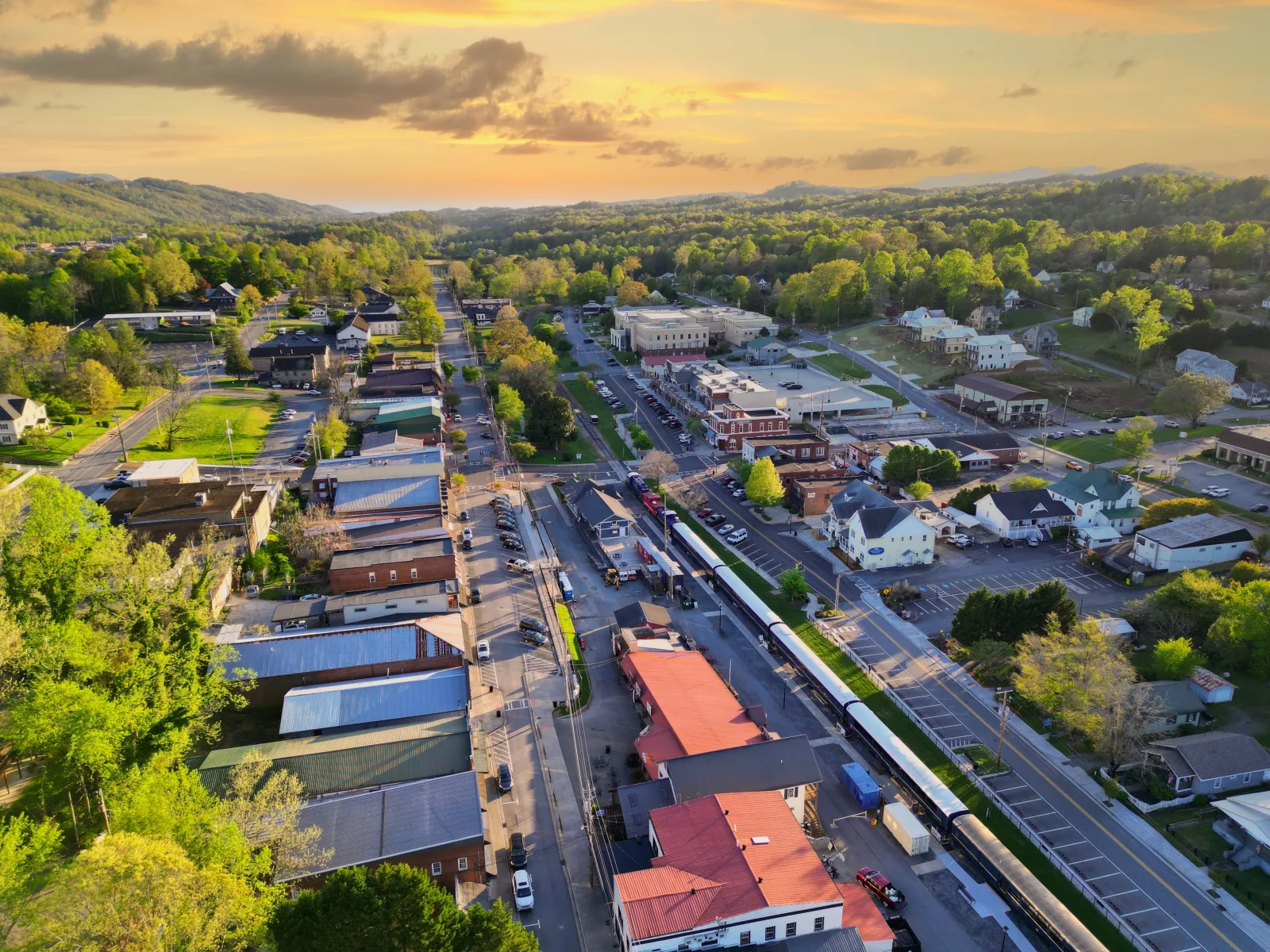
Blue Ridge works at a different scale. The galleries sit within a few flat blocks of the Scenic Railway depot, so you park once and walk. The trade-off is depth: you will not find dozens of working studio buildings here.
What the town has instead is recognition out of proportion to its size. In 2016, the Georgia Council for the Arts and the Georgia Municipal Association listed Blue Ridge among the Top 5 Art Towns in Georgia, and the association reports five straight years among the top ten fine craft towns in America in American Craft Week rankings.
How do you plan a gallery walk in the North Georgia mountains?
Avoid Mondays, and work methodically from west to east. The Art Center is closed Mondays, and starting there gives you the history and the class board before the private rooms on East Main.
- Late morning: The Art Center, 420 West Main Street. Allow an hour for six gallery spaces.
- Midday: walk east toward the depot for lunch downtown.
- Afternoon: High Country Art, 4 Elements Art, and Multitudes Gallery.
- Along the way: look for the painted fish of the Trout Art Trail.
That last element is a piece of local humor rendered in public sculpture. The association bills it as “The one and only Trout Art Trail in the United States,” a nod to Blue Ridge’s other title as the trout capital of Georgia. For the rest of the trip, our Exploring Blue Ridge guide covers where to stay and eat.
What if a gallery weekend turns into a search for a place here?
Then walkability becomes a genuine real estate consideration. I’m Thomas Echea, a Blue Ridge real estate agent and Luxury Real Estate Advisor with E+E Group at Compass, and the buyers who fall for downtown usually want to keep walking to it.
A cabin near the center puts the Art Center, the galleries, and dinner inside a short walk, but it trades acreage and long views for that convenience in Fannin County. Our guide to owning a cabin near downtown Blue Ridge lays out those trade-offs. When a GAMLS listing says close to town, ask for the drive time to Main Street, not just the distance.
Frequently Asked Questions
Where can you find traditional Appalachian art and craft in Blue Ridge?
Start at The Art Center at 420 West Main Street, where the Blue Ridge Mountains Arts Association teaches chair caning, cobweb broom making, and weaving, and hosts quilt and fiber exhibitions. For a full week of traditional craft, the John C. Campbell Folk School in Brasstown, North Carolina, is about 31 road miles away.
How does Blue Ridge’s art scene compare to Asheville, North Carolina?
Asheville is larger, with a dedicated River Arts District still rebuilding after Hurricane Helene. Blue Ridge is smaller and more walkable: its galleries sit within a few blocks of the Scenic Railway depot. Asheville is about 136 road miles, or roughly three hours, from Blue Ridge.
What are the hours at The Art Center in Blue Ridge?
As of October 2026, The Art Center is open Tuesday through Saturday from 10 a.m. to 6 p.m. and Sunday from 11 a.m. to 5 p.m. It is closed on Mondays.
When is Fall Arts in the Park 2026 in Blue Ridge?
Fall Arts in the Park runs October 10 and 11, 2026, from 10 a.m. to 5 p.m. in the Downtown City Park. Free shuttles run from the Blue Ridge Farmers Market and Blue Ridge Middle School from 9 a.m. to 6 p.m. both days.
Can visitors take an art class in Blue Ridge?
Yes. The Art Center’s fall 2026 workshops are open to nonmembers, with totals from $65 to $325 including supplies. Rosters are small, from four to eight students, so registering ahead by phone at (706) 632-2144 or online is the safer plan.