
The Quick Version
- Lake Blue Ridge fishing is best for walleye, rainbow trout, and bream; Georgia has stocked walleye every year since 2017.
- Walleye run shallow from February through April and deep, 30 to 50 feet, through summer.
- A Georgia fishing license costs $15 a year for residents and $50 for nonresidents; trout need a second license.
- Anyone born on or after January 1, 1998 needs boater education to run a motorboat or jet ski. Last updated September 2026.
Lake Blue Ridge rewards the angler who fishes slow and deep. The 3,290-acre TVA reservoir holds walleye, rainbow trout, largemouth and Alabama bass, catfish, and jumbo yellow perch. Georgia’s Wildlife Resources Division puts its distinction plainly: “Blue Ridge is the only large reservoir that is stocked with rainbow trout.”
This is the weekend playbook: what bites when, the licenses and boating rules, the river below the dam, where to swim, and how to fit a trail into the same trip. For the lake’s history, access points, and the town, start with our local’s guide to Lake Blue Ridge.
Is Lake Blue Ridge fishing good in 2026?
Yes, if you come for walleye, trout, and big bream rather than the smallmouth the lake was once known for. The state has stocked walleye fingerlings every year since 2017, and the WRD Lake Blue Ridge fishing forecast reports recent catch rates “well above the historical average,” with most fish between 2 and 4 pounds.
The bass story is the cautionary one. Alabama bass, illegally introduced in the early 1990s, now outnumber largemouth roughly 3 to 1. Smallmouth have fallen to less than 1% of the black bass community, even after state and federal hatcheries stocked 290,000 smallmouth fingerlings from 2016 to 2023.
Rainbow trout are the newest addition. More than 30,000 have gone directly into the lake over the last two years, released between the dam and Morganton Point at about 11 inches.
What bites when on Lake Blue Ridge?
Spring is the shallow season and summer is the deep one. From February into spring, walleye and spawn-run white bass work the Toccoa River arm of the lake. By summer, walleye hold on rocky points at 30 to 50 feet and deeper, following schools of blueback herring.
| Species | Best window | Where to look | Daily limit |
|---|---|---|---|
| Walleye | February to April shallow; dusk and night all year | Toccoa arm ledges, then deep main-lake points | 8 |
| Rainbow trout | Shallow early in the year; deep from May to October | The 1.5 miles above the dam, where TVA runs an oxygen diffuser | 8 |
| Alabama and largemouth bass | April spawn; fall on main-lake points | Pea-gravel coves in spring, 20 to 40 foot humps in summer | 10 black bass, only 5 smallmouth |
| Bluegill and redbreast | May to July spawn | Shallow coves in the Toccoa arm, nests down to 20 feet | 50 |
Walleye are shy of light, so the state’s biologists point anglers to dusk, dawn, and the night hours. Their core advice is to fish “much slower than you would for most other species.” Live blueback herring are also legal bait here, since Blue Ridge is one of ten named Georgia lakes where they are allowed.
Why do anglers fish the Toccoa below Blue Ridge Dam?
Because the tailwater is its own fishery. TVA describes the river below the dam as “noted among anglers for its sunfish, trout and bass,” and a canoe and kayak launch there gives paddlers access. The Toccoa runs northwest into Tennessee, where it becomes the Ocoee.
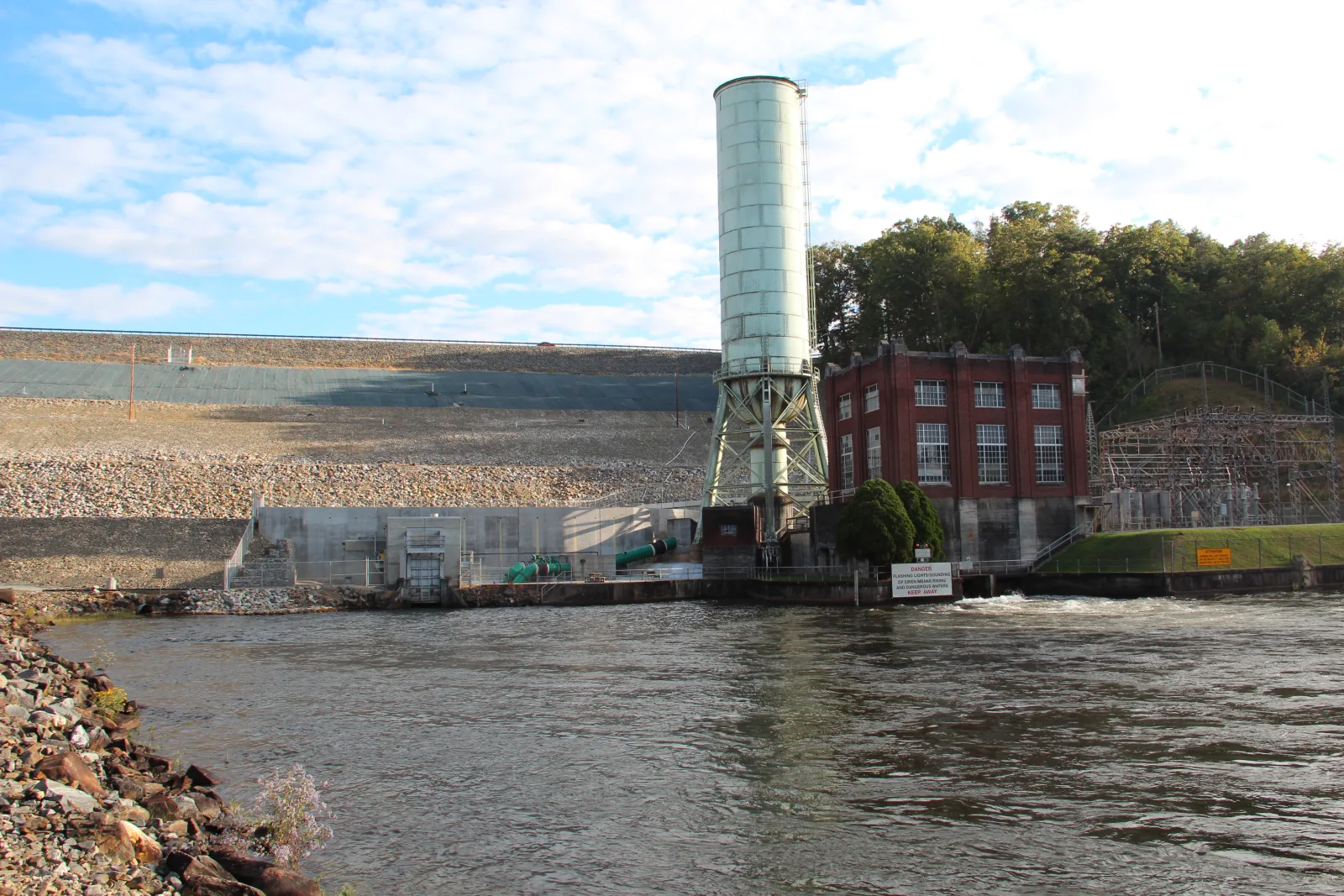
The release schedule runs the day. When TVA generates, the agency says the river becomes “a Class I-II float through the Georgia hills.” Its lake-levels page carries the line every wading angler should read first: “Large amounts of water could be discharged at any time.” Check the Blue Ridge release schedule before you step in.
Above the lake, a separate stretch of the Toccoa on Forest Service land is a delayed harvest stream. It runs from 0.4 miles above Shallowford Bridge to 450 feet above the Sandy Bottom Canoe Access, and from November 1 to May 14 it is catch and release with single-hook artificial lures. For owning on that water, see our guide to Toccoa River cabins.
Where are the fish attractors on Lake Blue Ridge?
At seven marked sites built between 2006 and 2008. WRD, TVA, and local volunteers sank PVC fish structures, and WRD publishes the coordinates as a free GPS download. We pulled the file on September 30, 2026 and tallied it: 123 PVC units across seven sites, at recorded depths of 30 to 35 feet.
| Site | Latitude | Longitude | Placed | PVC units | Depth |
|---|---|---|---|---|---|
| BLU1 | 34.87185 | -84.2595 | May 2008 | 26 | 30 ft |
| BLU2 | 34.85453 | -84.27621 | May 2008 | 27 | 30 ft |
| BLU3 | 34.81893 | -84.26376 | May 2006 | 4 | 35 ft |
| BLU4 | 34.83378 | -84.27306 | May 2007 | 19 | n/a |
| BLU5 | 34.83977 | -84.28308 | June 2007 | 19 | n/a |
| BLU6 | 34.851 | -84.24997 | June 2007 | 19 | n/a |
| BLU7 | 34.84245 | -84.25661 | June 2007 | 9 | n/a |
BLU1 and BLU2 alone hold 53 of the 123 units. Treat the points as a starting place and let your sonar confirm what is still down there.
What licenses do you need to fish Lake Blue Ridge?
A Georgia fishing license for anyone 16 or older, plus a trout license if you fish for or keep trout. These are the fees in the Georgia fishing regulations, current as of August 27, 2026.
| License | Resident | Nonresident |
|---|---|---|
| Annual fishing | $15 | $50 |
| One-day fishing | $5 | $10 |
| Each added day | $1 | $3.50 |
| Annual trout add-on | $10 | $25 |
| One-day trout add-on | $5 | $10 |
| Each added trout day | $1 | $2 |
A worked weekend: a nonresident fishing Saturday and Sunday for trout pays $13.50 for fishing and $12 for trout, or $25.50, plus a $3 transaction fee online. For a couple, add Morganton Point’s $5 day-use fee per adult per day and a $5 launch fee each day, and two days on the water come to about $87.
What are the rules for boats, jet skis, and paddle craft?
The lake is open to motorboats, jet skis, and paddle craft, per the Forest Service, and Georgia’s core rules fit on an index card:
- Anyone born on or after January 1, 1998 must complete approved boater education before operating any motorized vessel.
- Any boat with a motor, even an electric trolling motor, must be registered.
- Each person aboard needs a wearable life jacket, and children under 13 must wear one while under way.
- Stay at idle within 100 feet of a dock, an anchored boat, swimmers, or a public swimming area.
- Operating a boat under the influence of alcohol or drugs is illegal.
Paddlers get the calmest water early, before the ski boats are out, and in the coves away from the main channel.
Where can you swim at Lake Blue Ridge, and is it safe?
The standard answer is the designated swimming area at Morganton Point, which the Forest Service lists with beach access, picnic tables, and outdoor showers. Day use costs $5 per person 16 and older, and a $50 annual pass covers up to four people for swimming, day use, and boat launches at the concession areas. Alcohol is not allowed in the day-use areas.
The river below the dam is a different decision. Generation can raise the Toccoa quickly, which is why TVA posts both its schedule and its warning. Swim the lake beach, and wade the river only when the schedule shows no releases. For any water-quality advisory, the Georgia Environmental Protection Division is the source.
How do you fit a trail into a North Georgia mountains weekend?
Start with the drive. Downtown Atlanta to Blue Ridge is about 93 road miles by the fastest route, a little under two hours without traffic by our routing check, so a Friday arrival leaves Saturday for the water.
Morganton Point has a day-use trail that parallels the lakeshore, and the Appalachian and Benton MacKaye trails both pass through Fannin County near the campground. Our Blue Ridge hiking trail guide covers trailheads and mileage.
- Saturday at first light: walleye or trout on the main lake.
- Midday: swim and picnic at Morganton Point.
- Late afternoon: check the TVA schedule, then wade the Toccoa below the dam.
- Sunday: a lakeshore walk or a stretch of the Benton MacKaye before the drive home.
What if one weekend turns into a place on the water?
Then the questions shift from bait to deeds and dock permits. I’m Thomas Echea, a Blue Ridge real estate agent and Luxury Real Estate Advisor with E+E Group at Compass, and a private dock changes how you fish this lake more than any lure does.
Scarce frontage, TVA’s dock limits, and the winter drawdown all shape what you pay in Fannin County. Our guide to living on Lake Blue Ridge covers those costs, and the comparison of river vs. lake waterfront helps if the Toccoa pulled harder. When a GAMLS listing says lake access, ask whether that means a dock, a shared ramp, or a walk to Forest Service shore. Better yet, rent a cabin on Lake Blue Ridge first and fish from it.
Frequently Asked Questions
Is Lake Blue Ridge a good lake for fishing?
Yes, especially for walleye, rainbow trout, and bream. Georgia has stocked walleye fingerlings every year since 2017, and state biologists report catch rates well above the historical average. Smallmouth bass, once the lake’s signature, are now less than 1% of its black bass.
How can you catch more fish on a mountain lake like Blue Ridge?
Fish slower and deeper than you would on a lowland lake. In summer, walleye and trout hold at 30 to 50 feet near schools of blueback herring, so use electronics to find the bait. Fish dusk and night for walleye, and try the state’s seven fish attractor sites at 30 to 35 feet.
Do I need a trout license to fish Lake Blue Ridge?
Only if you fish for or keep trout, which the lake now holds. The trout license is an add-on to the regular fishing license: $10 a year for residents and $25 for nonresidents, on top of $15 and $50 for the fishing license.
Can I leave my boat on Lake Blue Ridge through the winter?
You can, but plan around the drawdown. TVA lowers the lake about 22 feet from summer to winter, so a boat at a shallow private dock can end up on the bottom. A slip in deeper water or dry storage are the usual answers.
Are the rivers and lakes near Blue Ridge safe to swim in?
The designated swimming area at Morganton Point is the standard choice on the lake. The Toccoa below Blue Ridge Dam can rise quickly when TVA releases water, so check the release schedule before wading, and check the Georgia Environmental Protection Division for advisories.
How long is the drive from Atlanta to Lake Blue Ridge?
About 93 road miles from downtown Atlanta to Blue Ridge by the fastest route, or a little under two hours without traffic.
What are the best hiking trails around Lake Blue Ridge?
Morganton Point has a day-use trail that parallels the lakeshore for a short walk after a swim. For longer days, the Appalachian and Benton MacKaye trails both pass through Fannin County near the campground.