
The Quick Version
Building new in Blue Ridge trades a known price for a chosen one. Unincorporated Fannin County has no zoning, yet it enforces published setbacks, septic approval ahead of the building permit, and an inspection sequence running from footer to certificate of occupancy. Georgia’s statewide construction code changed on January 1, 2026, and any contractor charging over $2,500 must hold a state license you can verify online in minutes.
- No zoning does not mean no rules: structures sit 15 feet off property lines and 50 feet from road center, and work may not start until the permit is issued.
- Septic comes first. Georgia sizes tanks by bedroom count, so the floor plan and the drainfield are one decision.
- The 2024 International Residential Code, with Georgia amendments, became the mandatory statewide minimum this January.
- Resale benchmark while weighing bids: Blue Ridge listings asked a median $327 per square foot in September 2026.
New construction homes in Blue Ridge, GA arrive two ways: a builder’s spec house you can walk through this weekend, or one you commission on land you chose first. Both answer to the same checklist, setbacks, and inspectors. Here is the paperwork, the sequence, and the vetting questions, taken from county documents rather than a sales brochure.
Should you build new or buy an existing cabin?
Build when the land matters more than the move-in date; buy when the reverse holds. That sounds glib until you price certainty itself. A resale market can be read from a desk. A custom project is a series of bids, and no citable local construction cost per square foot exists in any public source, so the only real number is the written quote in front of you.
| Decision factor | Building new | Buying resale |
|---|---|---|
| Cost basis | Bids plus lot, well, septic, driveway. Site surprises surface once excavation starts. | Asking prices are public: ZIP 30513 ran a median $327 per square foot in September 2026 (realtor.com research data), median listing 2,372 square feet. |
| Timeline | Permit approval, then every checkpoint below, on a schedule weather sets as much as the crew does. | Median Blue Ridge listing logged 81 days on market in September 2026; a contract closes in weeks. |
| Condition risk | Everything new, workmanship unproven. | Inspectable up front. Many cabins predate today’s code, with septic sized to the original bedroom count. |
| Financing | Construction lending differs from a purchase mortgage; describe the project to a lender before buying the lot. | A standard mortgage. |
One code detail tilts the comparison this year. The 2024 International Residential Code with Georgia amendments became the mandatory statewide minimum on January 1, 2026, per the Department of Community Affairs. A house permitted now is built to a newer standard than a spec home finished in 2025. Worth asking about when two similar houses carry similar prices.
Does Fannin County’s lack of zoning mean anything goes?
No, and the distinction decides your site plan. The county development authority states it plainly: there is no zoning in unincorporated Fannin County, McCaysville, or Morganton. What replaces it is a permitting layer with teeth. Setbacks put every structure at least 15 feet from property lines, 50 feet from the center of the road, 50 feet from state waters, and 20 feet from power lines. Parcels near creeks or inside mapped floodplain need a site plan first.
Inside Blue Ridge city limits, the order reverses. The checklist requires all City of Blue Ridge approvals in hand before the county application begins, plus a municipal water and sewer tap or an approved alternative. Near the boundary, confirm jurisdiction in writing before design work starts. Rules, sequence, and utilities all change at that line.
What permits does a new home in Fannin County need?
A residential building permit from 400 West Main Street in Blue Ridge, and the application is a package, not a form. The county’s permitting checklist, current as of November 2025, asks for the deed (or lease with owner’s approval letter), survey if one exists, proposed plans, and the lot corners and footprint physically marked on the ground. A driveway connecting to a county road needs its own permit. The form even requests exact directions and the gate code; GPS is not assumed here.
The item that surprises buyers is the order: an approved septic permit or sewage evaluation belongs in the application, so Environmental Health goes first. Georgia’s on-site sewage rules tie tank capacity to bedrooms, 1,000 gallons covering one through four and another 250 gallons each beyond that, making floor plan and septic design a single decision. Fannin keeps those records on paper, no online lookup, and later grading, fill, decks, or drives over the system can void its approval. Remember that when landscaping season arrives.
Two more lines from the county set expectations well. Construction should not begin until the permit is approved and issued. And the property receives no 911 street address until the foundation is complete, which says something true about how raw the starting point can be.
What inspections happen between permit and move-in?
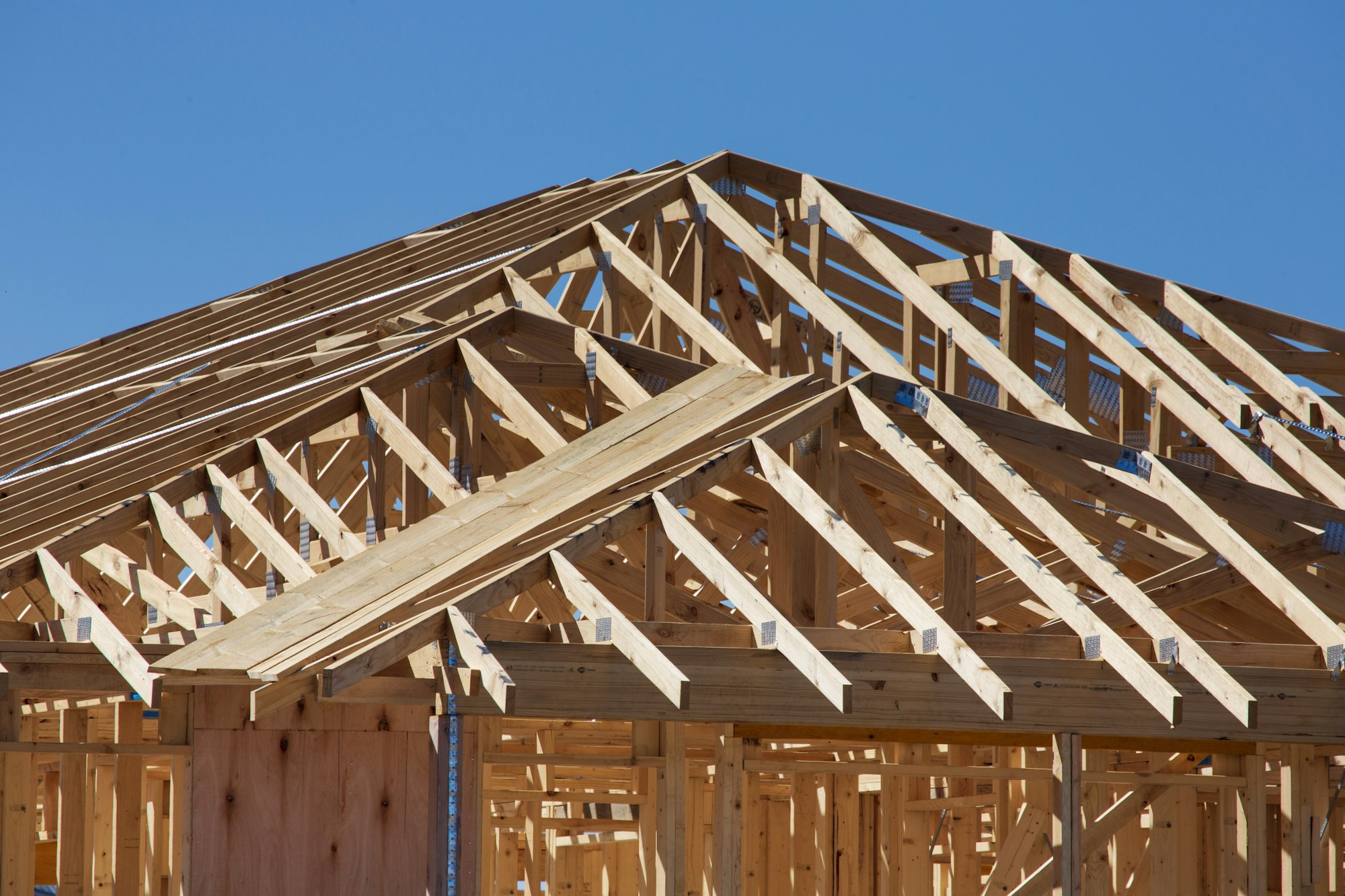
Up to seven checkpoints in fixed order, each gating the next phase, per the county’s published inspection requirements. The yellow permit copy must stay posted and visible on site, or inspectors will not proceed.
| Checkpoint | When it happens |
|---|---|
| Foundation (footer) | Footings dug, rebar placed; concrete may not be poured until it passes. |
| Slab | Before slab concrete goes down, where the design uses one. |
| Framing and plumbing | Framing, plumbing, and HVAC roughed in, ahead of any insulation. |
| Rough-in electrical | Wiring complete, before insulation or drywall covers it. |
| Final electrical | All wiring done. A pass is what the county sends the power company to request service. |
| Energy test | Independent blower-door and duct test, required by the state energy code on new living space; results filed with the county. |
| Final (certificate of occupancy) | Carpentry, masonry, electrical, plumbing, HVAC complete. Required before anyone moves in. |
Read that table as a payment map, not merely compliance. A draw schedule releasing money as checkpoints pass keeps the builder’s incentives aligned with yours, and it hands an out-of-town owner verifiable progress without weekly site visits.
How do you vet a builder in the North Georgia mountains?
Start with the license, because Georgia makes checking easy and the law makes it binary. Residential contracting over $2,500 requires a state license under O.C.G.A. Chapter 43-41; operating without one is a misdemeanor. The Secretary of State’s licensee search shows status, classification, expiration, and disciplinary history, free. Anyone casual about licensing will be casual about inspections too.
Then ask the mountain questions, because building in the North Georgia mountains differs from subdivision work. How many houses finished on steep grades? Who coordinated well and septic on the last three projects? What happened when excavation hit rock, and who paid? Which houses can you drive past, and which owners will take a call? Request certificates of general liability and workers’ compensation coverage directly from the carrier, never a photocopy.
Reputation in a small county outlasts any review site. I’m Thomas Echea — I have spent 25+ years advising buyers and sellers here, and I own a home in Blue Ridge myself, which means I have listed and resold local builders’ work years after the punch list closed. Performance at resale is the review that matters, and that history shapes which builders I introduce clients to when a search turns into a build.
What does a mountain lot add to the budget?
Everything a city lot gets from the street. Water often means drilling a well; the 2015 federal water-use census put 38.7% of Fannin County residents on one. Sewer means the tank sized above.
Access means a driveway cut into grade, sometimes via shared gravel, where Georgia law is blunt: under O.C.G.A. 32-1-8 counties may not maintain private roads, so a written maintenance agreement among neighbors is the only mechanism keeping yours passable. Get well, septic, and access answers during due diligence, before falling for a view. Our guide to land and lots for sale in Blue Ridge walks through what to check on a parcel before you buy it.
If that list reads long, the buy-side alternative is covered in the guide to cabins for sale in Blue Ridge, from pricing to the rural systems a resale inspection should cover.
Where should you start?
With both doors open. Spec houses and newly finished builds surface alongside resales on the Blue Ridge, GA properties page, and walking a few tells you quickly whether someone else’s floor plan will do. Recent examples include 103 Dry Branch Trail on 4.17 wooded acres and 44 Staurolite Mountain Road, a custom five-bedroom home in a gated community. Pre-construction is a third route: at North Creek in Mineral Bluff, buyers choose a homesite and finishes before the build. For a feel of the town itself, start with the honest picture of daily life in Blue Ridge and my guide to Blue Ridge.
When the question becomes a specific lot, builder, or spec house priced against resale comps, talk it through with me. Bring the bid; I will bring the comps.
Frequently asked questions
Do you need a building permit to build a house in Fannin County, GA?
Yes, and work may not start until it is approved and issued. Inside city limits, municipal approvals come before the county application. The Building Department sits at 400 West Main Street, 706-632-8361.
Is there zoning in Blue Ridge, GA?
Unincorporated Fannin County, McCaysville, and Morganton have none. The City of Blue Ridge does regulate land use within its limits, and permits, setbacks, septic approval, and inspections apply everywhere.
What are the building setbacks in Fannin County?
Per the November 2025 checklist: 15 feet from property lines, 50 feet from road center, 50 feet from state waters, 20 feet from power lines. Confirm current figures before finalizing a site plan.
Do home builders in Georgia need a license?
Yes, for residential work over $2,500, under O.C.G.A. Chapter 43-41; unlicensed contracting is a misdemeanor. Verify status and disciplinary history through the Georgia Secretary of State’s online licensee search.