
The short version: Whether you buy a condo or townhome in Fort Lauderdale decides which inspection regime you inherit. Broward County starts at 25 years of age, and fee-simple townhouses sit outside the program entirely.
- A condominium parcel is your unit plus an undivided share of the common elements (Fla. Stat. §718.103). A fee-simple townhome is a lot you hold outright (§720.301).
- Milestone inspections and reserve studies follow the form of ownership, never the shape of the building.
- Broward Policy #05-05 exempts “Fee Simple Townhouses” from its Building Safety Inspection Program. No condominium gets that pass.
- The county’s 2026 lists cover properties built in 1966, 1976, and 2001.
- Money for the components a structural integrity reserve study names can no longer be voted down.
Last updated July 2026.
Floor plans lie. A condo and a townhome can share a wall, a footprint, and a builder, then land on opposite sides of Florida’s inspection law. The deed decides. Everything expensive follows the deed.
So the question behind choosing a condo or townhome in Fort Lauderdale is not how many stairs you want. It is which obligations you agree to fund for as long as you hold the keys.
Condo or townhome in Fort Lauderdale: what actually differs?
Ownership structure carries the whole difference. Florida defines a condominium parcel as “a unit, together with the undivided share in the common elements appurtenant to the unit.” Your unit is “a part of the condominium property which is subject to exclusive ownership.” Roof, slab, pipes inside the wall: common elements. You hold a slice of each.
A fee-simple townhome inverts that. Under Florida’s homeowners’ association statute, you take a “parcel” — a lot “capable of separate conveyance.” Land included. Membership stays “a mandatory condition of parcel ownership,” so covenants still bind you. You simply answer for your own walls.
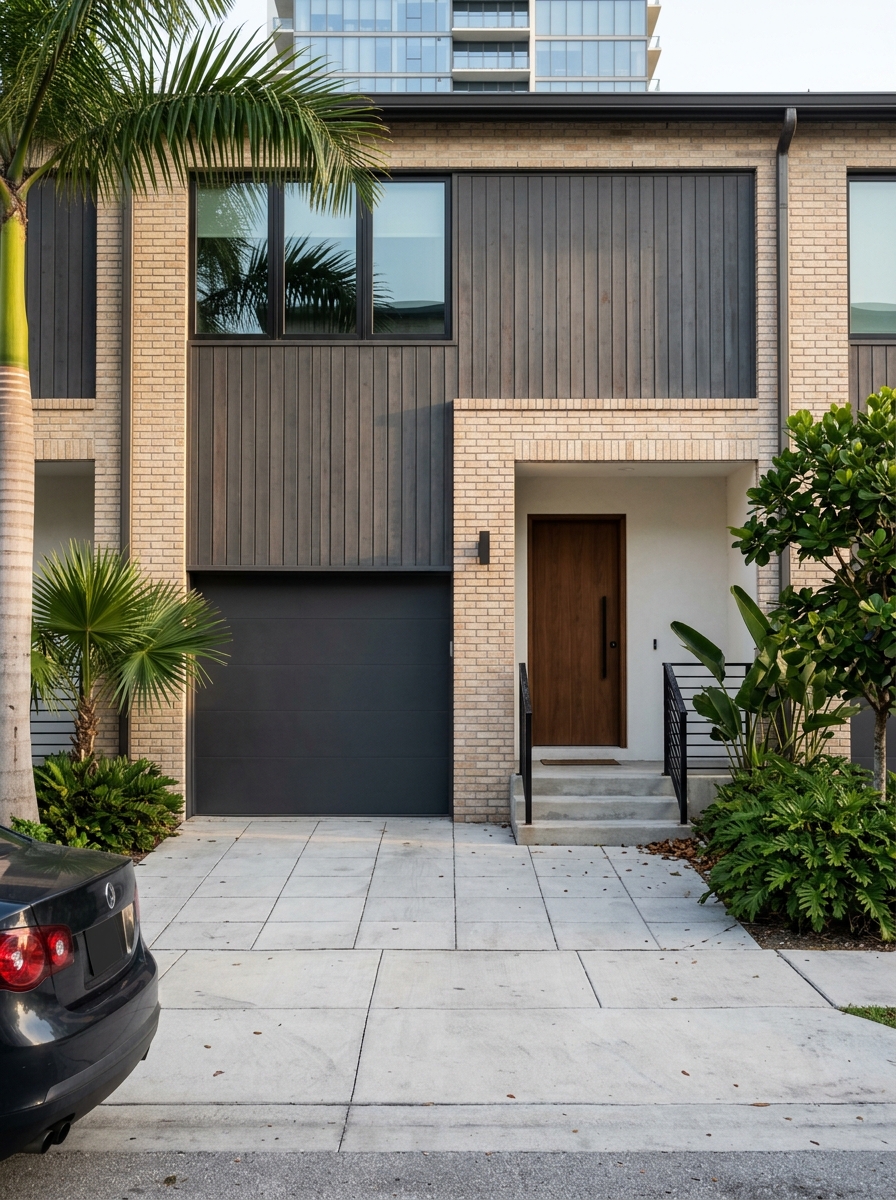
Here is what most buyers miss. “Townhome” describes a building. “Condominium” describes a deed. Developers plat rows of townhouses as condominiums all the time, and once they do, the law treats them like any tower. A listing headline proves nothing. The declaration proves everything.
What does the association actually control?
In a condominium the association insures the shell and you insure the inside. State law requires its policy to cover “all portions of the condominium property as originally installed or replacement of like kind and quality, in accordance with the original plans and specifications.”
Then comes the carve-out. Outside that master policy: “floor, wall, and ceiling coverings, electrical fixtures, appliances, water heaters, water filters, built-in cabinets and countertops, and window treatments.” As §718.111(11)(f)(3) puts it: “Such property and any insurance thereupon is the responsibility of the unit owner.” That sentence is your HO-6 policy’s entire job description.
A fee-simple townhome skips the split. Citizens Property Insurance, created by the state, says it plainly: “When you own a house, you own the house. That means you’re responsible for the entire structure.” Roof included. That is an HO-3, and nobody stands between you and the claim.
How do the two compare side by side?
The middle column is bills an association can send you. The right is work nobody else does.
| Dimension | Condominium unit | Fee-simple townhome |
|---|---|---|
| What you own | Unit + undivided share of common elements (§718.103) | Parcel, structure and land (§720.301) |
| Who insures the shell | Association master policy, as originally installed | You, all of it |
| Your policy | HO-6: finishes, appliances, cabinets, window treatments | HO-3: the whole building |
| Milestone inspection (§553.899) | Yes, at 3 habitable stories or more | Exempt |
| Reserve study (§718.112(2)(g)) | Yes, every 10 years | Exempt |
| Broward Building Safety Inspection Program | Covered from 25 years of age | Exempt (Policy #05-05, §I.C.6) |
| Reserves waivable? | Not for study components, budgets from Dec 31, 2024 | Covenants govern |
| Who funds repairs | Every owner, by assessment | You |
Why do milestone inspections land on condos and not townhomes?
Because the statute describes a deed rather than a doorway. Section 553.899 reaches buildings “three habitable stories or more in height” that are “subject, in whole or in part, to the condominium or cooperative form of ownership.” Hold a townhouse in fee simple and that sentence never finds you.
Broward moves earlier than Tallahassee. The statute sets the first milestone at 30 years, then lets a local enforcement agency drop it to 25. Broward took the 25. Policy #05-05, effective May 11, 2023, orders inspection “where such buildings or structures reach twenty-five (25) years of age or older, based on the date that the certificate of occupancy was issued,” repeating every 10 years.
The same policy names who walks free: one- and two-family dwellings, minor structures under 3,500 square feet, and “‘Fee Simple Townhouses’ as defined in the Florida Building Code.” Two words carry that exemption. Fee simple.
Cost rides with the duty. Broward assigns it to the building: “The owner or association shall be responsible for all costs associated with the inspection and any resulting required repairs and/or modifications.” Inside a condominium, “the association” means you and your neighbors, split by share.
What does a reserve study add on top?
It prices the bones, then locks the funding. Under §718.112(2)(g), condominium buildings three habitable stories or higher need a structural integrity reserve study at least every 10 years. It must price the roof, load-bearing walls and primary structural members, fireproofing, plumbing, electrical systems, waterproofing and exterior painting, windows and exterior doors, plus anything else carrying deferred maintenance above $25,000.
Now the clause that moves money. Owners in a unit-controlled association subject to a study “may not determine to provide no reserves or less reserves than required” for those items, for budgets adopted on or after December 31, 2024. The old vote-it-away move died. A board may postpone the study itself for at most 2 consecutive budget years right after a milestone inspection, so cash goes toward repairs instead.
None of this touches a fee-simple townhome. Your reserve study is your savings account. Your discipline is the only enforcement.
How do you check a building before you make an offer?
Six moves, none needing a seller’s blessing. Broward’s rules board answers the buyer’s version directly:
“I want to sell or buy a property. How do I verify that it has passed the safety inspection? Contact the building department within the city or county where the property is located. The building department maintains all records for the buildings.” — Broward County Board of Rules and Appeals, Building Safety Inspection Program brochure, September 2024
- Pull the folio and certificate-of-occupancy year from the Broward County Property Appraiser, downtown at 115 South Andrews Avenue, Room 111, or at (954) 357-5579.
- Do the arithmetic. A certificate dated 2001 lands a building in the 25-year cohort for 2026.
- Email rulesboard@broward.org with that folio and address to confirm the building sits on an official list.
- Ask the city building department for the report, exactly as the county instructs.
- Read the declaration. It settles whether a townhouse-shaped building is legally a condominium.
- Read the budget beside the study. A $25,000 line item the budget ignores is a future assessment wearing a disguise.
What clocks start once a notice arrives?
Two. A Notice of Required Building Safety Inspection allows 90 days to inspect, then 180 days from the report to finish what it demands. Boards must also give every owner the inspector’s summary, post it on site, and publish it online. Sellers who cannot produce that paperwork have not escaped it.
Related reading: Riverwalk living in downtown Fort Lauderdale covers the daily texture of the district, and current Fort Lauderdale listings show what trades now.
Frequently asked questions
Is a townhome always exempt from Florida’s milestone inspection?
No. The exemption tracks the deed, not the silhouette. Section 553.899 reaches any building “subject, in whole or in part, to the condominium or cooperative form of ownership,” so townhouses platted as condominiums qualify. Broward Policy #05-05 exempts “Fee Simple Townhouses” alone.
Does Broward County use the 25-year or the 30-year trigger?
Twenty-five. Section 553.899 defaults to 30 years and permits a local enforcement agency to require 25. Broward Policy #05-05, effective May 11, 2023, triggers at 25 years from the certificate-of-occupancy date, recurring every decade.
Can a condominium board vote to skip funding structural reserves?
Not for components named in a structural integrity reserve study. Section 718.112(2)(g) bars owners in a unit-controlled association from choosing “no reserves or less reserves than required” for those items, in budgets adopted on or after December 31, 2024.
Who pays for a milestone inspection and the repairs it finds?
The building, which inside a condominium means every owner. Broward Policy #05-05 assigns “all costs associated with the inspection and any resulting required repairs and/or modifications” to the owner or association. In a fee-simple townhome that bill is yours alone.
Will an HO-6 policy cover a special assessment for structural repairs?
Do not plan on it. Citizens Property Insurance includes loss assessment coverage “of up to $2,000” in HO-6 policies, describing those assessments as “typically for deductibles and repairs not covered by a condo-unit policy.” That language points at covered losses. Ask your carrier what your form actually does.
None of this is legal advice, and no article reads a declaration for you. Association records, plus a Florida attorney who handles these documents for a living, will say what a given building truly owes. Thomas Echea, who owns homes in Blue Ridge and Fort Lauderdale, treats that reading as part of the work rather than a formality.